
Rereading

On my shelf lays a battered, aged, book—its corners disfigured and its pages wrinkled by the constant, relentless use. Its cover is stained by coffee and, flipping the pages close to your nose, you can discern the smell of smoke and incense.
This book is my bible—of sorts. My muse. My creative role model. The book of books, written in the twenty-first century, yet whose value I place higher than any classic, and, believe me, I value the classics.
That book, whose name I shall not provide, and whose author must remain anonymous, to you at least, having nothing against you, my merely being a superstitious character—that book—I have read more than fifteen times, from cover to cover.
I remember the first time I came across it. I was still in college, grappling with my identity, my writing, and my political positions. The world back then felt fragile—as it always does when you care too much—on the cusp of a new era, socially and politically, and I, like most college students, had to find an intellectual home.
To do that, I had decided, what better way, to immerse myself in books across spectrums, doctrines, and ideologies, which made the Strand, an independent bookstore with floor-to-ceiling shelves that extended into a vast maze, my second home.
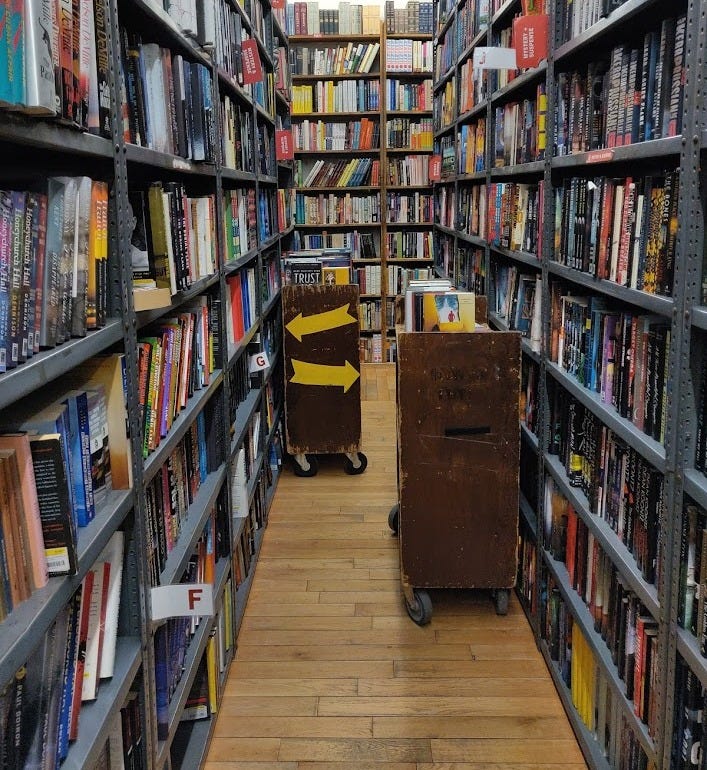
Everyday after college, I would walk to the Strand with a warm coffee in my hands, navigate myself around the first floor’s carefully-curated exhibits, mostly appealing to the mass market reader and the tourist, and make my way to the basement, where you can find books on politics, history, philosophy, and the occult. Being a broke college student, I rarely bought books; instead, I often meandered around the labyrinth until I found a secluded spot to sit and read in peace. And read I did.
But I quickly found out that there was so much non-fiction you could ingest before your mind started having an allergic reaction to the words. To mitigate that, I interlaid my theory reading with some light fiction.
And that’s when I found the book. It was abandoned by another reader, on a rack, having deemed it unsuitable for their taste, perhaps. I picked it up, dusted it off—a sign that it wasn’t being re-shelved, and thus, surely neglected—and flipped through its pages, carefully observing its structure, length, and style of prose.
I fell in love immediately. I read the first chapter holding my breath, not because it was suspenseful but because it was electric—you know, the feeling when aesthetics and prose collide just the right way to form images and feelings that are felt strongly within. That’s what I felt. And I kept feeling that, anew, every time I re-read it.
There is not a single paragraph of that book that I haven’t examined. Not a single line that has gone unnoticed. In fact, I can recite most of it from memory. I am one with the book, a hybrid, and confident that I can, in my own unique ways, reproduce the creativity and the moral lessons present in that book in my own writing. I am not talking about stealing; no, I am talking about a source of deep, unwavering inspiration that comes from mastery of the material.
Why obsess over a book when there is so much to read out there?
Because it is from dogma that writers are made. It is from relentless repetition and the creative undoing thereof that knowledge is internalized. Do not misjudge familiarity with understanding. We all do that. To know that we understand something beyond a superficial grasp, we need to tap into the source of the material, extract it, literally and in our own words, tinker with it, and apply it to new contexts other than the one we discovered it in. Then and only then we will be able to declare mastery and apply knowledge and information worthy of replication into new perspectives.
Rereading is also about moral, subconscious formation. As we age, our existence will become increasingly filtered as robustness is stripped from us, leaving us naked for the world to see what we are made of. Before our minds start collapsing into the subconscious patterns accumulated throughout the course of life, “rehearsals of who [we] will become when everything complex is stripped away”—known as dementia personality—we should take the cultivation of our minds seriously. Read broadly to discover material and expand your horizons, but also reread what captures your imagination and inspires your senses. Reread books, over and over again, without guilt, knowing that repetition is not a useless monotony but an invitation to relive the text each time with a new set of eyes and embed worlds within you, worlds that will follow you forever.
What a delight to see a link to this post in my inbox this morning. Your writing is brilliant. You took me right with you into the basement at the Strand.